
Summary:
- Medical and cosmetic mole removal in Malaysia are not interchangeable. Which applies is determined by a dermatologist’s assessment, not personal preference.
- If your mole has changed in asymmetry, border, colour, diameter, or appearance, get it assessed before booking any procedure.
- Laser is ablative and does not preserve tissue for biopsy analysis. The assessment determines which method is appropriate.
- Cosmetic removal is out of pocket. Medical removal may be covered by insurance when a dermatologist documents medical necessity.
- In Malaysia’s UV climate, sun protection on the healing site directly affects pigmentation outcomes, particularly for medium to darker skin tones.
Noticing a change in a mole is rarely dramatic. A glance in the mirror before work. A partner who mentions it over dinner. A photograph where something looks off. For most people, the realisation arrives quietly, followed by a search for what to do next. Others already know their mole is benign and simply want it gone. Either way, mole removal in Malaysia is not one thing.
There are 2 pathways, medical and cosmetic, and which one applies is determined by a dermatologist’s assessment, not personal preference. That assessment is where the process starts, because the method, the cost, and whether insurance applies all follow from it.
What Is the Difference Between Cosmetic and Medical Mole Removal?
Medical removal prioritises complete excision (full surgical removal) and tissue testing. Cosmetic removal prioritises a clean aesthetic result on a mole already confirmed as benign.
| Factor | Medical Mole Removal | Cosmetic Mole Removal |
| Clinical goal | Complete excision; tissue sent for analysis | Clean aesthetic result on a confirmed benign mole |
| Who determines the pathway | Dermatologist, based on clinical assessment | Dermatologist confirms benign status first |
| Methods typically used | Surgical excision with margin; biopsy may precede removal | Laser treatment, cryosurgery, electrosurgery |
| Biopsy involved | Yes, in most cases | No |
| Insurance or medical benefits | May be covered when medical necessity is documented; check with your insurer | Out-of-pocket; elective procedure |
| Cost structure | Varies by insurer and policy terms | Priced per mole; method and number treated affect total |
These 2 pathways differ in method, cost, and insurance treatment, so knowing which applies before your consultation matters.
Warning Signs Your Mole Needs a Medical Assessment First
Not every mole that concerns you will turn out to be a medical case, but the ABCDE criteria help you tell the difference. It is a 5-point early-warning checklist used to identify mole features that warrant a clinical assessment.
Each letter corresponds to a specific visual characteristic: Asymmetry, Border, Colour, Diameter, and Evolution. They are a widely used framework, not a diagnostic test.
| Letter | Stands For | What to look for |
| A | Asymmetry | One half of the mole does not mirror the other |
| B | Border | Irregular, ragged, or poorly defined edges |
| C | Colour | Uneven tone or multiple shades within one mole |
| D | Diameter | Wider than 6mm, roughly the size of a pencil eraser |
| E | Evolution | Any change in size, shape, colour, or texture over time |
If a mole you have had for years shows any of these features, have it looked at rather than monitor it yourself.
A mole that raises one of these flags is not automatically cancerous. What matters is that if you choose a mole removal laser treatment, it does not yield tissue for analysis. Proceeding without an assessment first means choosing a method that may not be the right one.
If any of the above apply, the right first step is a skin assessment, not a booking form.
The Most Common Reasons for Cosmetic Mole Removal
Cosmetic mole removal is typically chosen when a mole has been confirmed as benign, and the reason for removal is practical or personal rather than clinical. The most common reasons include:
- Catching on a collar, necklace, bra strap, or razor during daily routines
- Visibility on the face or neck, particularly in areas seen in photographs or on video calls
- Discomfort caused by friction from clothing or jewellery
- Personal preference, including simply not wanting the mole to be there.
If your mole has been cleared by a dermatologist, cosmetic mole removal is a straightforward elective procedure.
One point worth raising with your dermatologist before choosing a method: laser leaves no wound to close, which typically means a shorter recovery, but surgical mole removal in Malaysia allows the tissue to be sent for analysis as a precaution.
For most confirmed benign moles, either can work. The right choice depends on the mole’s depth, location, and your skin tone.
What Happens at a Mole Assessment in KL?
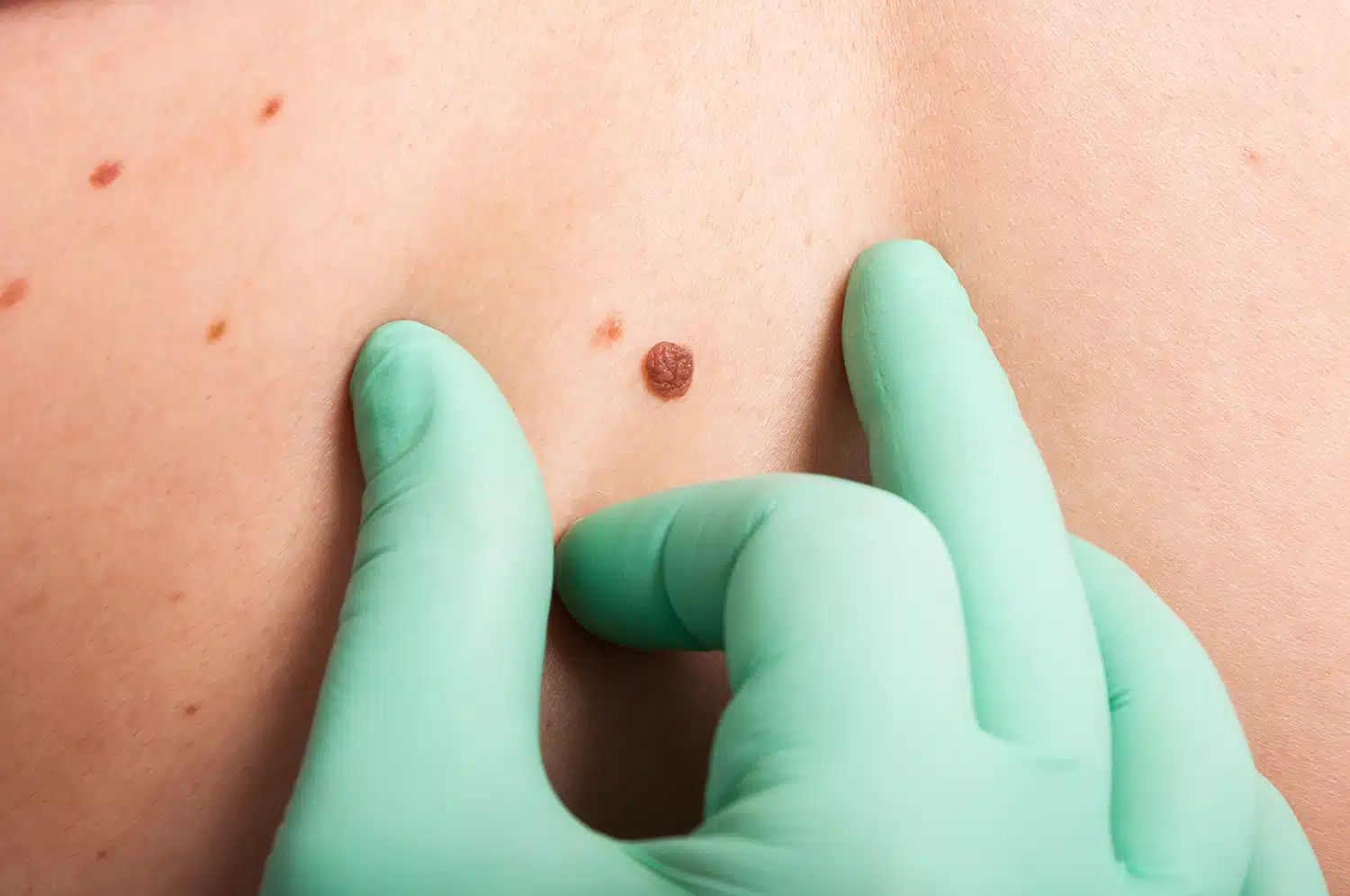
Before any method is recommended, a dermatologist examines the mole using a dermatoscope: a magnification device that reveals pigment patterns and structural detail not visible to the naked eye. What the assessment finds shapes every decision that follows.
| Check | What It Involves | Why It Matters |
| Visual examination | Assessment of size, shape, colour, border, and surface | Identifies features that warrant further investigation |
| Dermatoscopy | Magnified view of pigment patterns and structural detail | Reveals subsurface features not visible to the naked eye |
| Patient history | How long the mole has been present; any recent changes | Establishes a baseline and flags evolution over time |
| Photography | Reference images taken for monitoring or records | Documents current state; useful if follow-up is needed |
| Biopsy (where indicated) | Tissue sample removed and sent for laboratory analysis | Confirms whether the mole is benign before any removal proceeds |
For moles with irregular features, a biopsy may come before removal rather than after. It is the step that ensures the right procedure is used on the right mole.
Recognising a change is the hardest part. Dr Gan Teck Sheng will assess your mole and confirm whether mole removal in Malaysia is the right next step. Get in touch with us and take the uncertainty off the table.
The Procedures Used in Each Case Are Not Interchangeable
The method has to match the clinical goal. Applying laser to a mole that requires surgical excision does not achieve the same result, and in some cases produces a worse outcome.
Each procedure below differs in how it works, whether tissue is preserved, and what recovery involves:
| Procedure | Used For | How It Works | Biopsy Possible | Typical Downtime |
| Surgical excision | Medical removal; raised moles requiring full clearance | Mole removed with a scalpel under local anaesthetic; wound closed with sutures | Yes, tissue sent for analysis | 7 to 14 days surface healing; longer for full scar maturation |
| CO2 laser ablation | Flat benign moles; cosmetic removal | Laser vaporises surface pigment layer by layer; no incision or stitches | No | 7 to 14 days as a crust forms and separates naturally |
| Pigment-targeting laser | Flat moles with denser pigmentation | Fades colour across one or more sessions | No | Mild redness; lower disruption than CO2 |
CO2 laser mole removal is the most common approach for flat, confirmed benign moles. For deeper or denser pigmentation, a pigment-targeting laser may be a better fit.
The absence of biopsy in laser cases is only appropriate when the mole has already been assessed and confirmed to be benign. If any clinical concern remains, surgical excision is the right method.
In Malaysia’s UV climate, consistent sun protection on the healing site is not optional, regardless of which procedure is used.
Every mole responds differently. Dr Gan Teck Sheng’s assessment narrows that down to a single, specific recommendation for yours. Schedule your assessment at GTS Dermatology and arrive already knowing what to expect.
Does Insurance Cover Mole Removal in Malaysia?
Whether medical mole removal in Malaysia is covered under your insurance depends on your insurer, your policy terms, and whether a dermatologist has documented medical necessity. What qualifies varies, so check with your provider first. Cosmetic mole removal is an out-of-pocket expense in all cases.
| Factor | Medical Mole Removal | Cosmetic Mole Removal |
| Insurance claimability | May be covered when medical necessity is documented; depends on insurer and policy | Not claimable; elective procedure |
| Pricing structure | Varies by procedure complexity and whether biopsy is required | Priced per mole; method and number of moles treated affect total |
| What to confirm before booking | Whether your policy covers dermatology procedures and biopsy costs | Total cost per mole and whether a follow-up visit is included |
| Additional costs to anticipate | Laboratory fees if tissue is sent for biopsy | Sunscreen and aftercare products; follow-up if needed |
Confirm with your insurer what your policy covers for mole removal in Malaysia and whether a specialist referral is required. That done, the question is which pathway applies to you.
Which Option Should You Choose?
Which pathway applies depends on a single question: has your mole changed, or has it already been assessed and confirmed as benign? If there is any change or uncertainty, the medical pathway comes first. If your mole is confirmed benign and your reason is practical or cosmetic, you are likely a cosmetic removal candidate.
Here is how to work through your specific situation:
- Your Mole Has Changed or Has Irregular Features: See a dermatologist before doing anything else. Do not book laser removal.
- Your Mole Has Been Previously Assessed and Confirmed Benign: You are likely a cosmetic removal candidate. A consultation confirms which method suits your mole type and skin tone.
- You Are Unsure Whether Your Mole Has Changed: That is exactly what a skin assessment is for.
- You Want a Mole Removed for Practical Reasons: Provided the mole is confirmed benign, this is a straightforward cosmetic case.
- You Want to Know Whether Insurance Covers Your Removal: A dermatologist documents medical necessity if it applies. Cosmetic cases are not covered, regardless of provider.